
PROJECT
Rogun Citadel
- STUDENT
- 코디르라몬
- STUDIO
- Studio 403
- PROFESSOR
- 고성석
- YEAR
- 2026
- CATEGORY
- 설계
STATEMENT
Guarding Memory at the Waterline
Rogun is set to become the tallest dam in the world: 335 meters, on the Vakhsh River, rising just upstream of Nurek, the current second-tallest. It promises to end the winter blackouts most of Tajikistan still lives with, and to give the state something to export. What that promise costs is somewhere between forty-two and sixty thousand people, the project's own paperwork can't agree on the number, whose villages won't be relocated. They'll be drowned. Families get a new address; the old one stays exactly where it was, underwater, for as long as the dam stands. One reservoir, filled with one river, produces power for ten million people and erases the physical memory of fifty thousand others at the same time. That contradiction is what this building is actually about.
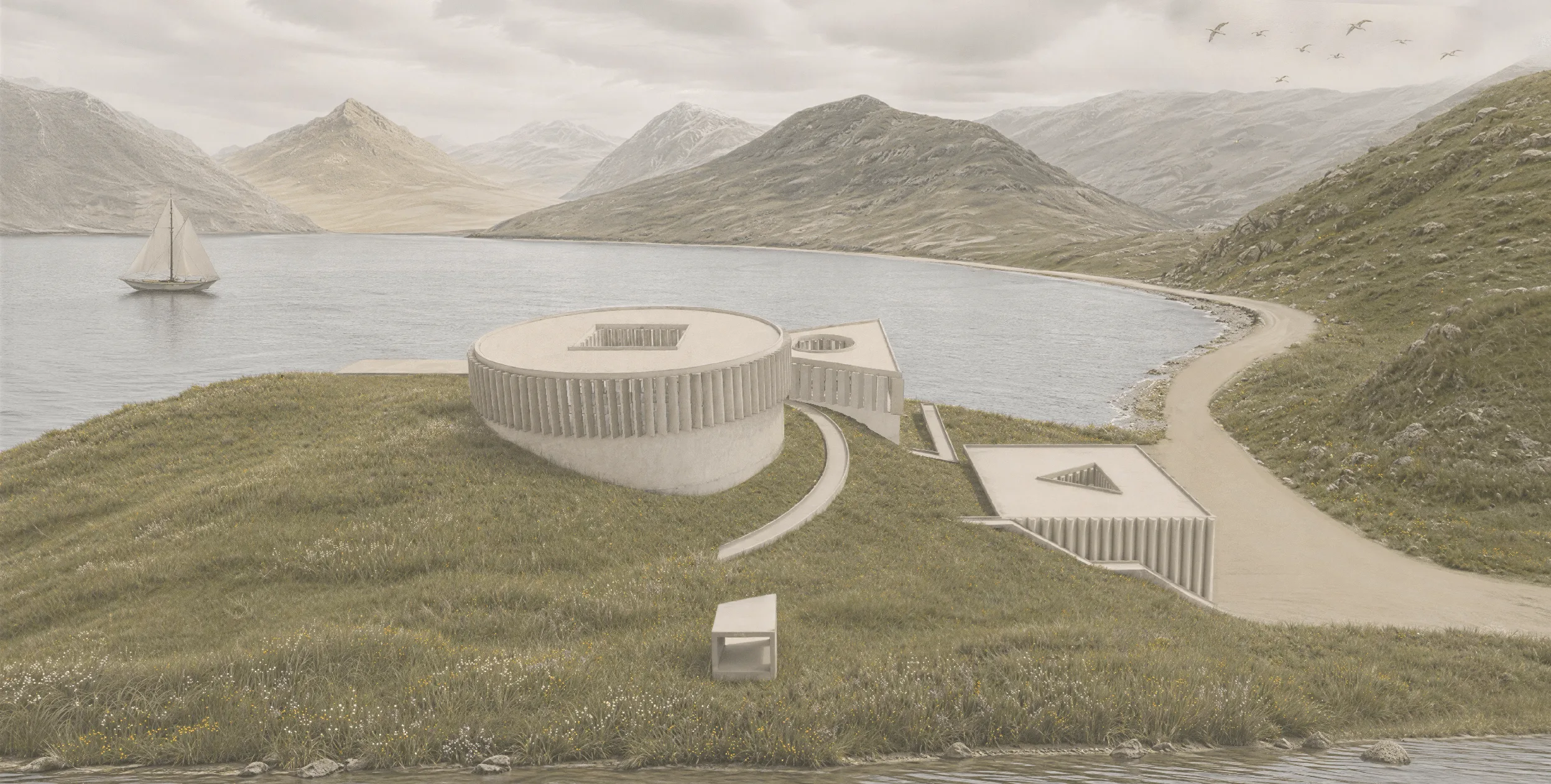
It sits on a ridge between the old settlements and the town built to replace them, close enough to an excavation the construction itself uncovered to hold four things in view at once: the dam, the new town, the dig, the drowned villages. A cross laid across the ridge points at each.
Its geometry borrows a Tajik ornamental triad: square, circle, triangle set in sequence toward the dam: square for memory, circle holding two ground levels together, triangle aimed forward. From above, that reads cleanly, three national forms on a cross. It doesn't survive the ground. A single low base runs underneath all three, shaped like the courtyard clusters of the villages being resettled, invisible from the air, doing the real work of holding the monuments up. Each building repeats the same reversal inside itself a square shell wrapped around a triangular void, faced in circles, and on around the set. Nothing here is what it looks like from a distance.
Underneath the forms: a memorial hall, a working wing with a lab and a monitoring center, a wing for exhibitions and energy conferences, and one continuous base carrying the history from before the dam through to whatever comes after ending where you can see all four conditions at once, together.